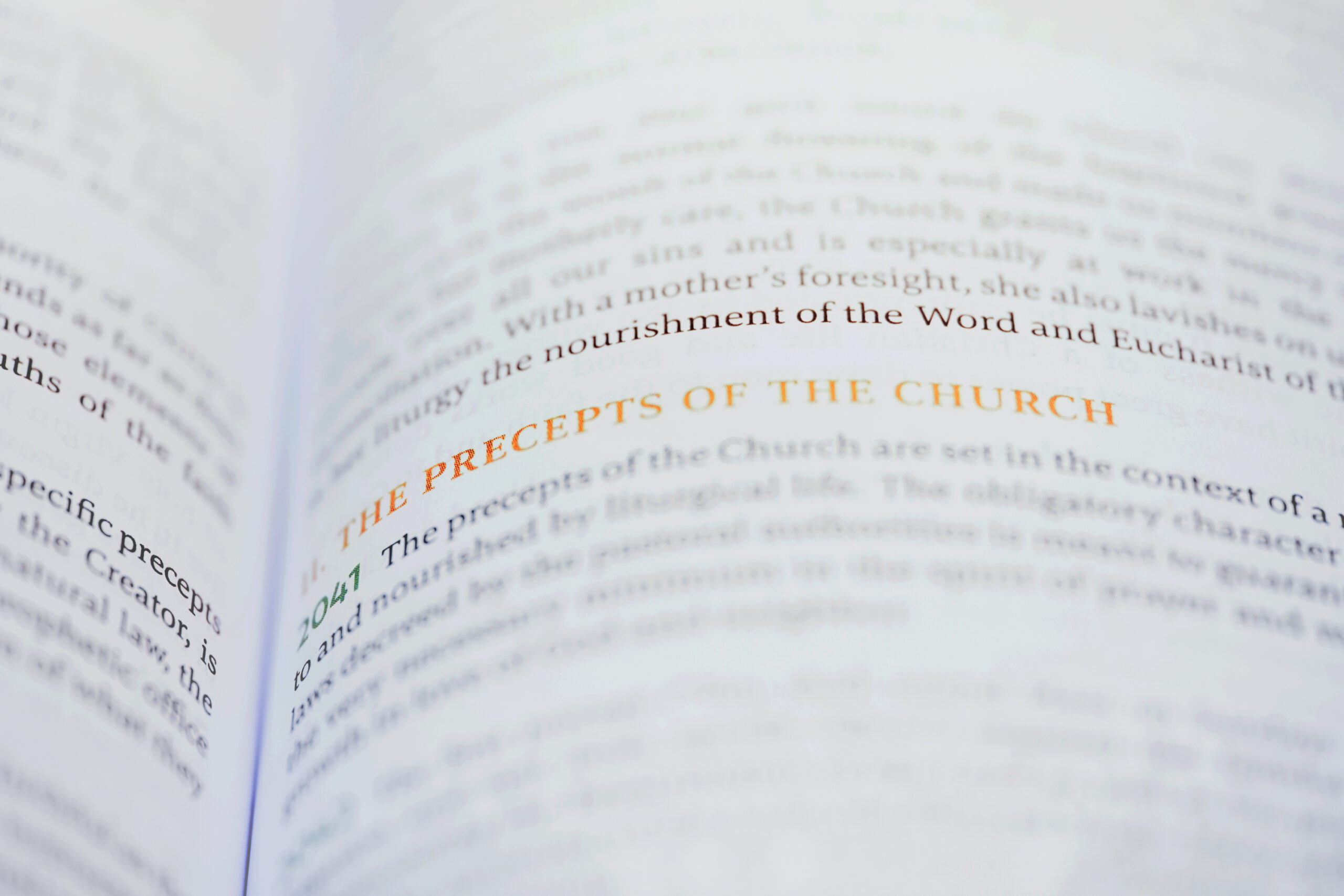
The 5 precepts of the church guarantee the very necessary minimum the faithful are obliged to observe liturgically; as such, you have a right to know them. Fulfilled, these saving precepts purify judgment and, with grace, heal wounded human reason.
The Benefits of Precepts
Set adrift, the human mind can wander into bad judgment and rough waters. The struggling and wearied mind, like the waterlogged roots of a tree, frustrates the growth of good fruit. The Church, in her wise heart, wishes to direct the mind elsewhere, toward peaceful streams— streams of good reason and right action. Once we know what we must necessarily do, we find it easier to avoid the rough current, to follow the course God has set for us, and to remain in quiet waters—the good life.

Gustave Brion, Jesus and Peter on the Water, 1863
‘You shall attend Mass on Sundays and on holy days of obligation and rest from servile labor.’
- CCC §2042
The catechism goes on to say “The faithful are required to sanctify the day commemorating the Resurrection of the Lord as well as the principal liturgical feasts honoring the mysteries of the Lord, the Blessed Virgin Mary, and the saints.”
The small moments of our days lie as humble threads in the tapestry of our lives. Each passing minute wants for the golden thread which pulls our life into a story; God has required us to keep this golden time, this sacred time, the holy days of obligation, so that our desire remains satisfied. In turn, these obligations bring the fabric of our tapestry into a unified whole depicting, by the grace of God, the story of a saint.
‘You shall confess your sins at least once a year.’
- CCC §2042
“This second precept ensures preparation for the Eucharist by the reception of the sacrament of reconciliation, which continues Baptism’s work of conversion and forgiveness.”
As the passions throw us like a violent sea from sin to sin, the sea-calmer, Jesus, stands firm atop the waves. Even as we fall into the depths of these chaotic waters, into venial or mortal sin, Christ offers us his hand in the confessional booth. This is the place we go, not to be condemned or judged, but to receive forgiveness. It can be humbling to admit when we have sunk into depths that require us to be saved yet it is precisely in these moments where many learn most of the love of God, of our fallen nature, and of our divine dependence. Do not be afraid. Reconciliation, like baptism, will pull you from the chaotic waters that wash over you, leaving you a new creation.
“You shall receive the sacrament of the Eucharist at least during the Easter season.”
- CCC §2043
“The third precept guarantees as a minimum the reception of the Lord’s Body and Blood in connection with the Paschal feasts, the origin and center of the Christian Liturgy.”
The source and summit of the Christian Life is what the church calls the Eucharist. Christ, the alpha and omega, the creator of the cosmos, has also entered into it, first as the incarnation and then as the transubstantial bread. And whats more? He has asked us to eat and drink of himself, the medicine of immortality, so we might join him in heaven for eternity as sons and daughters of the Father. It is therefore proper that on the “feast of feasts,” Easter, we are required to eat of this “food of foods” and “sacrament of sacraments.”
“You shall observe the days of fasting and abstinence established by the Church.”
- CCC §2043
“The fourth precept ensures the times of ascesis and penance which prepare us for the liturgical feasts and help us acquire mastery over our instincts and freedom of heart.”
Blessed are the poor in spirit. Blessed are those who hunger and thirst for righteousness, for they shall be satisfied. The words of our Lord have inspired great ascetics, holy men of fasting and abstinence, who have given up the world which once filled them so that they might become poor in spirit and thirst instead for the kingdom of God. The church calls all of us to this same holy way, though mercifully requires only a minor asceticism from most.
The Fifth Precept – Caring for the Church
“You shall help to provide for the needs of the Church.”
- CCC §2043
“The fifth precept means that the faithful are obliged to assist with the material needs of the church, each according to his own ability. The faithful also have the duty of providing for the material needs of the church, each according to his own ability.”
Aboard a boat, stowaways take food and hide away to eat, stealing from the passengers both food and their hands in work. The boat of the church, the barque of Peter, is not worried about running out of food for our food is Christ and mysteriously more abundant when emptied, but she is concerned with the care of the hull for she wishes to strain her capacities to take on as many as she can. We, unlike most ships, welcome stowaways and island wrecked survivors. This unique hospitality requires the work of all our hands, no matter how capable, no matter when you came aboard. If you have not been providing for the needs of the church in some way, do not worry, rather, get to work! Provide for the ark that saves you, the body of the one that made you, each according to his means.


