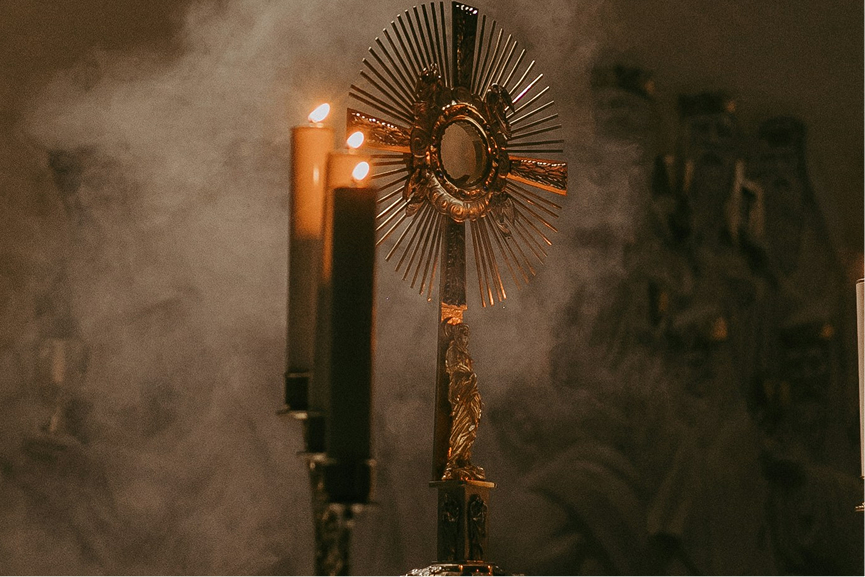
The third precept guarantees as a minimum the reception of the Lord's Body and Blood in connection with the Paschal feasts, the origin and center of the Christian Liturgy.
“You shall receive the sacrament of the Eucharist at least during the Easter season.”
- CCC §2043
“The source and summit of the Christian Life” is what the church calls the Eucharist. Christ, the alpha and omega, the creator of the cosmos, has also entered into it, first as the incarnation and then as the transubstantial bread. And whats more? He has asked us to eat and drink of himself, the medicine of immortality, so we might join him in heaven for eternity as sons and daughters of the Father. It is therefore proper that on the “feast of feasts,” Easter, we are required to eat of this “food of foods” and “sacrament of sacraments.”
Eat My Body; Drink My Blood.
“This is a hard saying; who can listen to it?” were the words of the apostles at Christ’s institution of the Eucharist. And why wouldn’t they be scandalized? Christ is saying we are to gnaw on his flesh and drink his blood. Yet, he doesn’t correct them as though they misunderstood him. Rather, he asks “Will you also go away?” to which all faithful reply with Peter “Lord, to whom shall we go? You have the words of eternal life.” And so we too confess that the Eucharist is truly the body and blood of Christ.
“The Eucharist and the Cross are stumbling blocks. It is the same mystery and it never ceases to be an occasion of division.”
- CCC §1336
Only Once per Year?
While required only once per year the church emphatically urges us to partake in the eternal food more often. Saints too join in her encouragement. St. Thérèse of Liseux says “Receive Communion often, very often… there you have the sole remedy, if you want to be cured. Jesus has not put this attraction in your heart for nothing.”
Receiving communion separates us from sin, past and future. Effectively, when we faithfully partake in that which is holy we become holy. As with prayer, fasting, and almsgiving, the more we surrender to God the more God rewards us— not always with momentary consolations but with eternal rewards.
“The reception of this sacrament ought to be prepared for by an examination of conscience made in the light of the Word of God.”
- CCC §1454


